Let’s start a conversation
Would you like to start conversation with BGaming in any field? Drop us a line!
CONTACT USRNG in iGaming: the system behind every spin
The question “What is RNG?” has probably crossed your mind at some point — most likely while reading a slot review. You’re not alone, and BGaming is here to walk you through the essentials.
In the iGaming industry, RNG stands for a random number generation algorithm that produces the numbers used to decide game results. As online gambling keeps growing and changing fast, knowing how this system works helps separate facts from myths and set clearer expectations.
This guide explains how outcomes are mapped in games, what types of titles use RNG, and how testing, certification, and rules support fairness in modern gambling.
Defining RNG
An RNG (Random Number Generator) is the system that creates random results in digital casino titles. In practice, it’s a software that continuously generates numbers, then uses them to decide what happens in a spin, deal, or draw. Without RNG, online casino games wouldn’t be able to deliver outcomes that feel truly unpredictable and consistent from one player to another.
When people talk about RNG gambling, they usually mean one thing, and it’s trustworthiness. A properly built RNG helps keep results unpredictable, so no one can “time” a win or predict the next outcome. It also supports full transparency by making the game logic open and testable. That’s where the idea of Provably Fair comes in as proof that outcomes follow fixed rules and aren’t changed on the go.
Answering the question “What is RNG in iGaming” also explains why it matters, as the technology replaced the old suspicion around online casino play with systems that can be audited, certified, and trusted.
Understanding RNG mechanics
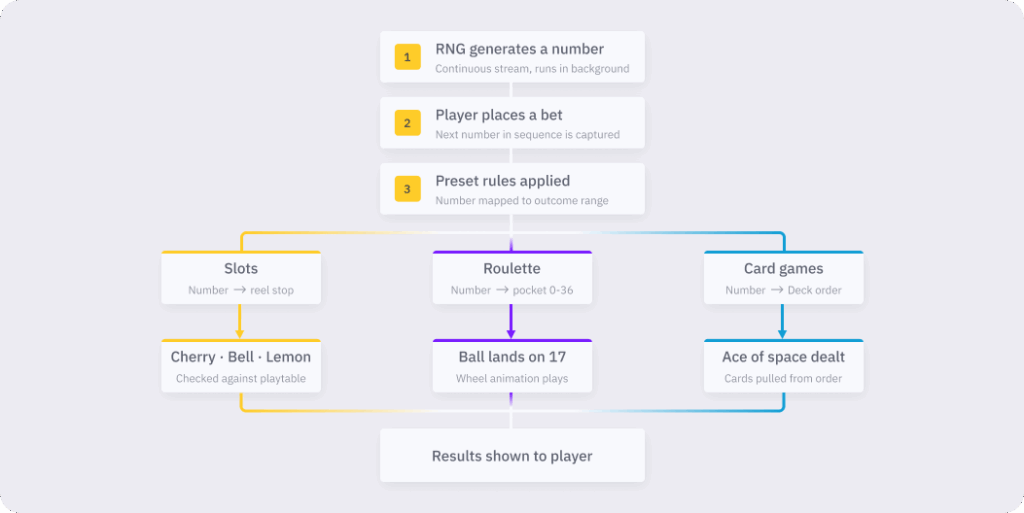
In RNG casino games, the number generator is a piece of software that creates a fast-moving sequence of numbers, even when you’re not clicking anything. The moment you trigger a spin or confirm a bet, it takes the next set of numbers in that sequence and converts them into a result using preset rules. Because it keeps running in the background, you can’t improve your chances by waiting for a “good moment” — you’re simply capturing whatever numbers happen to be next.
Each game type maps numbers to outcomes in its own way. Slots translate them into reel stops and symbol positions. Digital card games use them to choose the next card from a virtual deck. Roulette and dice use them to pick a pocket or a face value, while bingo uses them to select the next ball.
The sequence is built to be unpredictable, which means it has no trackable pattern for players. Every spin or draw is an independent event, because it is based on fresh random numbers rather than previous results. A win doesn’t make a loss due, and a long dry streak doesn’t make a bonus more likely, unless the game rules explicitly say so.
Where randomness comes from: TRNG & PRNG
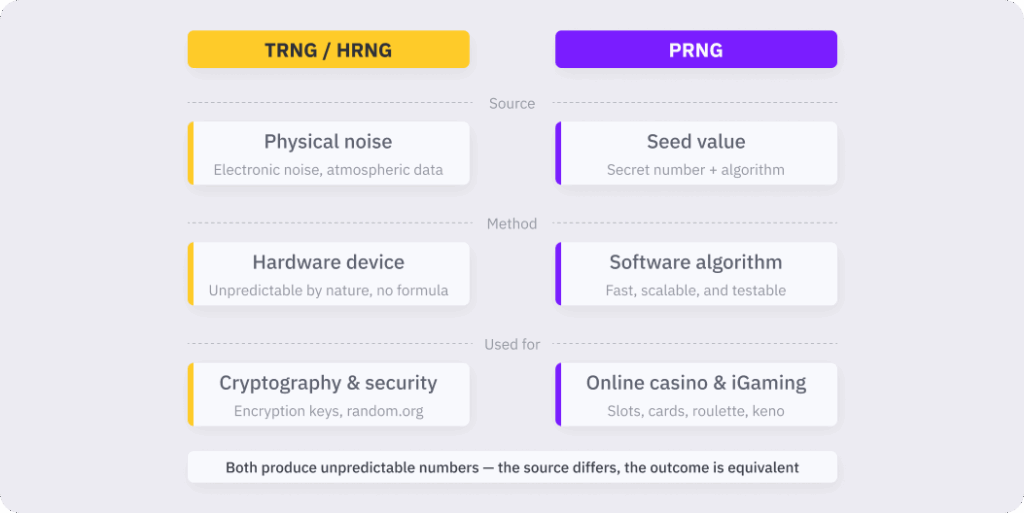
There are two main ways to generate randomness in gambling games: TRNG (True Random Number Generator) and PRNG (Pseudo-Random Number Generator). You may also see HRNG, where “H” means hardware, referring to a device-based TRNG.
An HRNG (TRNG) gets randomness from physical processes that are hard to predict, such as electronic noise or tiny timing variations in circuits. Because the source is physical, the output isn’t produced by a specific formula. That’s why hardware-based randomness is commonly used for security-sensitive tasks like creating cryptographic keys. Some services even offer this type of true randomness online, such as random.org, which generates numbers from atmospheric noise.
With PRNG,software uses an algorithm and a secret seed to generate number sequences that are statistically random and unpredictable, even though they are produced by maths rather than physical noise. It’s fast and easier to run, which is why most online games and RNG casino titles rely on PRNG-driven outcomes. In terms of security, it depends on the algorithm quality and seed protection. If the seed could be guessed or influenced, future results might become predictable.
Both approaches generate the numbers used in game mechanics, but they do it in different ways. Hardware-based RNGs draw randomness from physical noise, while software-based RNGs (typically PRNG-driven) use a secret seed and an algorithm to generate a long stream of numbers quickly.
What RNG means in iGaming
RNG in iGaming is the tool that keeps online casino games fair from one round to the next. It generates numbers constantly, and the game uses them to decide outcomes the exact moment you place a bet. Those numbers are then converted into results (e.g., slot symbols) through preset rules, which keep gameplay unpredictable while still allowing testing and review.
Game types that use RNG
Most non-live digital casino titles are RNG-based games. Slots are the clearest example, where each spin uses RNG to determine reel outcomes. The same process also triggers features such as Free Spins, Bonus rounds, and multipliers.
Virtual table games, like digital blackjack, video poker, or baccarat, work in the same way, using RNG to shuffle a virtual deck and deal cards. In virtual roulette or dice, it selects the winning pocket or face value, then the animation simply shows the game outcome that was already chosen.
In bingo, RNG software selects the next numbers to build winning patterns, while instant-win and casual games like scratch cards, mines, or plinko-style drops use it to decide the exact win/loss result or a multiplier.
To feel more confident about where you play, we advise you to look for a slot provider with certified RNG games. Independent labs hold extensive reviews and issue reports with certifications, so you’re not relying just on the iGaming content provider’s claims of fairness.
RNG and live dealer games
Live dealer games work differently from RNG-powered titles because the outcome comes from real-world equipment and a human dealer. Trustworthiness depends on transparent procedures and visible gameplay, such as proper dealing, correct wheel spins, and supervised shuffling methods. Unlike RNG games, which generate results through background software and are validated through technical audits and statistical checks, live outcomes are created physically on camera.
However, there are some live roulette variants that add a separate bonus layer, where the physical wheel result is paired with an RNG system that randomly assigns multipliers to selected numbers before the spin. The ball and wheel still decide the winning number, while the extra multiplier is generated separately and only applies if the ball lands on one of those boosted numbers.
It’s also worth mentioning the live fortune wheel-based game show formats, taking this mixed approach even further. As the human host spins the real wheel during the show, it can land on special segments that trigger bonus rounds, where extra multipliers or prize values are generated by the RNG game system.
How RNG numbers are mapped to game outcomes
When an RNG system generates numbers, the game still needs a way to turn them into different elements in the games you can actually see. This process is often called mapping, and is done through preset rules that connect number ranges to specific outcomes.
Each reel position and symbol in online slots is assigned an internal value (for example, Cherry = 1, Lemon = 2, Bell = 3, and so on). When you make a spin, the game grabs a fresh number set from the RNG and uses it to pick the exact stopping position for each reel. The reel animation is just the visual layer, followed by the stops that were already chosen. If the selected symbols line up in a winning pattern, the game pays according to its fixed paytable and rules.
Virtual roulette works in a similar way, but with a different outcome set. Instead of reel positions, the RNG output is mapped to numbers on the wheel, such as 0–36. Once the winning number is selected, the wheel spin you see is the representation of that result.
In the digital card games, the RNG is used to create a shuffled order for a virtual deck, then each deal simply pulls the next card from that order.
RNG security and fairness
Integrity in RNG gambling comes from proving that results are generated fairly and cannot be manipulated. Technical controls and independent testing confirm the RNG works as intended and that outcomes are mapped without bias. Regulatory oversight sets the requirements, audits compliance, and takes action when standards aren’t met. Together, certification and regulation back up fairness and keep player trust in place.
Certification
RNG certification is the practical way game providers move from claims to independent proof. It’s done through a third-party lab that reviews the RNG and delivers a report (paired with a certificate) for regulators and operators. Well-known testing labs that provide RNG-related services include BMM Testlabs, iTech Labs, GLI, eCOGRA, and TST.
The lab checks the RNG exactly as it runs in the live product, including the algorithms that turn numbers into symbols, cards, or roulette results.
Here’s what testing labs usually check during certification:
- Implementation review: the lab checks how the RNG algorithm is integrated into the game or platform, including the seeding approach and the exact calls used to generate numbers.
- Statistical testing: large samples of output are generated and put through statistical checks to confirm that the results behave like random data.
- Outcome distribution testing: the mapped results players see are also tested to confirm the rules that turn numbers into outcomes don’t change the intended odds (e.g., symbol frequencies in slots, card order after shuffles) and that rounds stay independent.
- Security controls:this step checks whether the results could be predicted or tampered with. It includes secure seeding, keeping RNG settings private, and making sure any changes are logged.
Think of this as testing two layers, where the first one is the RNG stream itself and the second is the game math that turns that stream into outcomes. If a slot converts number ranges into symbols, the test checks that this process doesn’t make some results more likely than intended or create hidden patterns.
Upon the lab testing completion, the certification pack includes:
- A written test report describing the RNG version tested and the methods used
- Statistical results (pass/fail summaries and key distributions)
- A certificate or letter confirming the RNG meets the relevant standard for the jurisdiction.
Also note that certification isn’t permanent, so fixes are usually tested again during audit cycles, and updates after launch may trigger another review. Regulators also expect scheduled re-testing (often annually) and third-party security audits, so older reports don’t stay valid forever.
Regulations
Fair play in online casinos is enforced through licensing rules set by gambling regulators. Before games go live, operators must show proof of RNG compliance, usually by submitting independent lab reports and keeping clear records of updates. Regulators also may require periodic re-testing, technical audits, and access to logs that confirm the approved version is the one running on the site. If an operator manipulates results or bypasses testing, penalties can include fines, mandatory refunds, suspension, or loss of licence, depending on the jurisdiction.
Badges and certification seals on casino websites can help players judge credibility, showing the casino platform has been reviewed by a recognized testing lab. They are usually located at the website’s footer. Clicking on these seals should redirect you to a verification page or report you can open and check. To make sure it’s valid, see the report date, what the certification covers, and which operator or casino it applies to.
Difference between RNG and RTP
These two terms are often mixed up because both come up in talks about fair play, especially in slot reviews where they’re mentioned side by side. However, each term describes a different layer: one relates to how outcomes are generated round by round, while the other is a long-term payout statistic built into the game’s maths.
Randomness is handled by the number generator behind the game. It keeps outcomes unpredictable and independent, deciding what happens each time you submit your bet based on preset rules.
Return-to-Player (RTP) covers the payout expectations as a long-term statistic built into the game’s maths that shows the expected percentage of total stakes paid back over a very large number of rounds. For example, 96% RTP doesn’t mean you will get back $96 from every $100 you bet that day.
Put simply, one concept deals with trustworthiness in each round, while the other describes the game’s overall payout level across the long run.
Myths and misconceptions about RNG
A lot of RNG myths come from treating random results as if they keep track of what happened before. In reality, each spin or deal is generated independently, so previous game outcomes don’t make the next one more or less likely.
One common example is the idea of hot slots and cold slots. A slot that has paid out recently can look hot, while a game on a losing streak can look cold, but those labels don’t change the odds. Unless a game has a stated feature that changes its behaviour, the RNG doesn’t store past results or set up a win or a loss.
After a long run of missed bonuses in slots, it’s easy to assume the opposite result is coming up soon. But randomness doesn’t balance out on a schedule, and streaks can happen naturally.
Another misconception is that someone can beat a random number generator by spotting patterns, timing spins, or using a prediction tool. In certified games, RNG output is designed to be unpredictable and is tested for statistical quality, so tactics like waiting, switching bet sizes, or counting spins won’t influence what the next result will be.
Why RNG matters for responsible gambling
Understanding how RNG works helps set realistic expectations, which is a key part of responsible gambling. For players, it’s a reminder that each result is random and independent, so there’s no reliable way to get back losses by changing stake size, switching games, or waiting for a better moment. That mindset makes it easier to stick to limits, treat sessions as entertainment, and step away when play stops feeling fun.
Operators benefit from the same clarity, since visible testing information and honest game descriptions reduce confusion and complaints. It also shows that the platform takes integrity seriously and isn’t hiding how results are produced. In regulated markets, this level of transparency supports safer play messaging, helps meet licensing expectations, and strengthens long-term trust between the casino and its customers.
BGaming titles
BGaming’s RNG has an official evaluation from iTechLabs and BMM Testlabs. On top of that, there is a range of games that have Provably Fair verification in addition to standard testing, which lets you make sure that each result was produced fairly using a built-in check on the round data. The picks below show how certified randomness powers our slots, table games, and casual formats.
- American Roulette: a digital 0/00 wheel where each ball landing comes from a certified RNG, with Provably Fair tools that let players verify the result.
- Maneki 88 Fortunes: a jackpot slot with Coin Wilds and four jackpots, with reel stops and feature triggers decided by random number generation.
- Plinko 2: a casual drop game with adjustable risk, where RNG keeps each ball outcome random within fixed rules and multipliers.
- Aztec Magic Deluxe: a Provably Fair slot that runs on a certified RNG, with reel outcomes generated randomly and wins paid according to the paytable.
Across these examples, each result is generated randomly, so there’s no possible way to time or predict outcomes. It’s worth trying these in free slots demos on our website to see how the fixed rules keep payouts consistent, testable, and fair.
Key takeaways
Behind most digital casino results, RNG technologies are the reason each bet result is independent. Once you understand how random numbers are converted into outcomes, it becomes easier to understand game characteristics, avoid common myths, and play with clearer expectations.
- Most non-live casino titles rely on random number generation to produce results.
- Each round is independent, and the past spins don’t affect the next one.
- TRNG and PRNG both produce the random numbers that games rely on, but one draws from physical noise while the other generates results through an algorithm and a seed.
- Random numbers are turned into results through preset game rules, such as reel stops in slots, shuffled decks in card games, or the winning number in virtual roulette.
- Live dealer results come from physical equipment, while some bonus layers may also be generated by an RNG system.
- Certification and regulatory bodies support trust through audits, retesting, and penalties.
- RNG and RTP measure different things, as one decides each round’s result and the other describes long-term payout.
FAQ
What does RNG stand for in online gambling?
RNG acronym stands for Random Number Generator, a system that produces random numbers used to decide outcomes in most non-live digital casino games, like online slots and virtual tables.
How are RNG results generated in online casino games?
The game takes RNG numbers the moment you bet, then applies preset rules to convert them into results like reel stops, dealt cards, or roulette numbers.
How do TRNG and PRNG compare?
TRNG draws randomness from physical noise, while PRNG creates statistically random sequences from an algorithm and a secret seed.
Can you realistically beat an RNG system?
No. Certified RNG outcomes are designed to be unpredictable and independent, so timing spins, switching stakes, or chasing patterns won’t improve your chances over time.
How is RNG different from Return-to-Player (RTP)?
RNG decides each round’s random result, while RTP is a long-term payout percentage built into game maths across many rounds.
How is an online casino’s RNG tested and confirmed?
Third-party independent labs hold reviews, run statistical and outcome-based tests, and check security controls. Regulators may require re-testing, audits, and logs to confirm the approved version is valid to get or maintain a certification.

Let’s start a conversation
Would you like to start conversation with BGaming in any field? Drop us a line!
CONTACT US