
Let’s start a conversation
Would you like to start conversation with BGaming in any field? Drop us a line!
CONTACT USRTP in Slot Games: How Return to Player Works?
Understanding what RTP is in slots gives you a quick way to compare games beyond themes and features by focusing on expected return. This guide breaks down RTP (Return to Player), how it’s calculated, and how it connects to volatility and random results. You’ll also learn why the same slot’s percentage can vary across sites, and how to use that number to pick games that fit your budget.
The meaning of RTP
RTP (Return to Player) is the payout percentage a slot is designed to pay back to players over the long run. Instead of predicting what you’ll win today, it describes what the game returns on average after many spins, calculated through complex mathematical algorithms that determine payouts. For example, a 96% RTP slot is built to return about $96 for every $100 wagered across a very large sample of play, with the rest representing the casino’s expected edge. Because it’s a standardized percentage, Return-to-Player helps compare slots on a clear baseline, and it also allows online casinos and regulators to judge whether a game performs as advertised and meets fairness expectations.
RTP calculation process
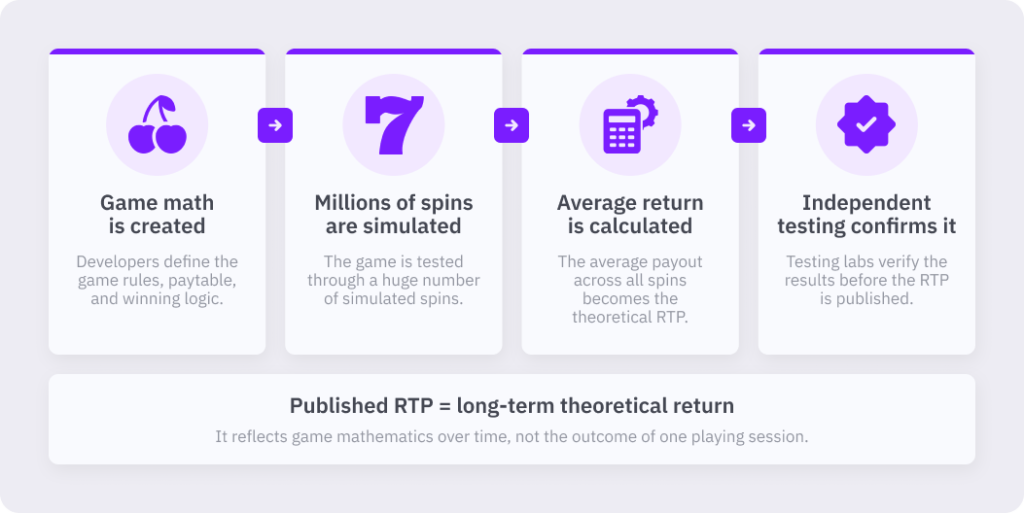
Game providers set RTP during development, and how to calculate RTP in slots comes down to large-scale testing rather than a simple formula. Using the game’s paytable and rules, they run computer simulations that replay millions or even billions of spins to estimate the average return. In regulated markets, those results are reviewed by regulators and independent testing labs, which verify that the slot behaves as advertised. Even with simulations and third-party checks, Return-to-Player stays a long-term statistical value, not a short-term prediction.
How RTP and volatility work together
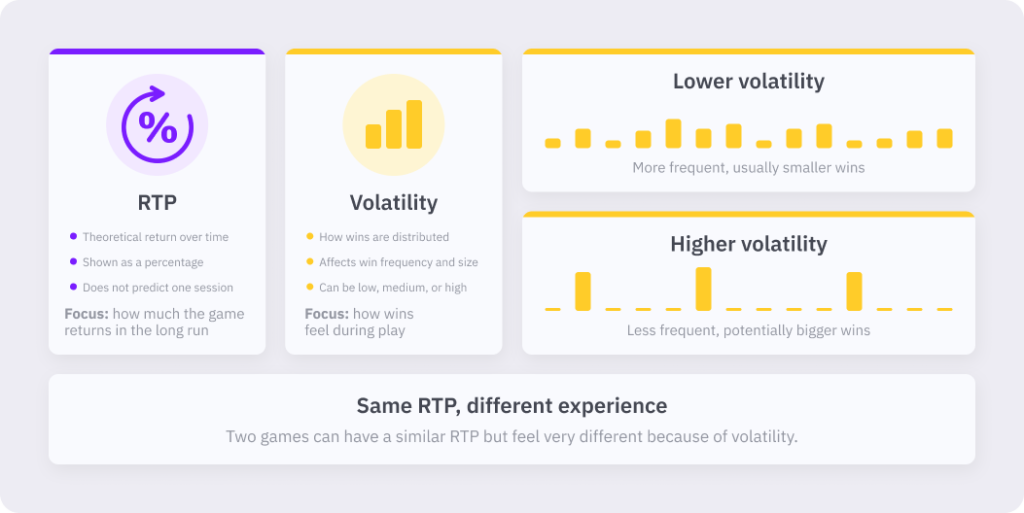
To understand a slot’s behavior, it helps to look at both RTP and slot volatility. RTP focuses on how much a slot is built to return over the long run, shown as a percentage. Volatility, on the other hand, is about win patterns, telling how often payouts appear and how large they can be when they hit. A slot can have a high Return-to-Player and still feel “cold” for long runs if it’s high volatility, because more of its value may sit in rarer, larger wins. Another game might show a similar RTP, but pay smaller amounts more regularly if volatility is lower.If your budget is tight or you prefer steadier action, lower volatility games usually deliver more frequent wins, even if they are modest. If you’re comfortable with longer dry spells and want bigger payouts, higher volatility can fit better. Online casinos and iGaming providers often display RTP alongside volatility so you can identify which online slots to play based on your risk comfort, session length, and bankroll, rather than choosing only by theme or bonus features.
The role of RNG (Random Number Generator)
A slot’s results are driven by a Random Number Generator (RNG), which determines the outcome for every spin. The key point here is independence, as each spin is random and does not keep track of what happened previously. A long losing run doesn’t mean a win is due, and a recent big payout doesn’t reduce your chances on the next spin. The RNG keeps the game unpredictable in the moment, serving as the foundation for fairness.
RTP works differently, since it’s the long-term payout ratio a slot is designed to return over a huge number of spins. In simple terms, RTP tells you the expected return over time, while the RNG controls how individual spins land. Put together, they explain why a slot is fair and still feels uneven across sessions.
RTP in action
The question “how does RTP work in slots?” is easiest to answer by looking at real play. The next sections explain how Return-to-Player reflects long-term averages, how a simple calculation works, and discuss the common misconceptions.
RTP as a long-term average
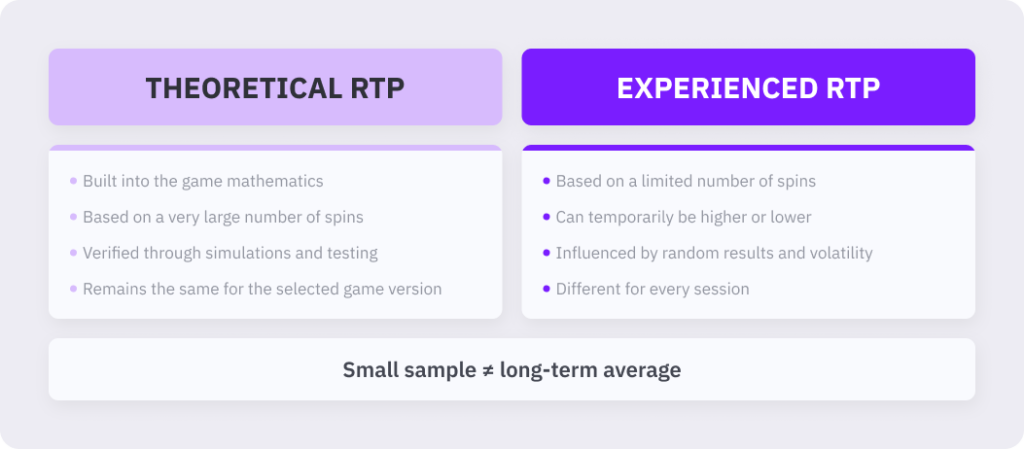
Published RTP reflects an average based on millions of spins, using the slot’s paytable and rules to estimate long-term return. A real session can land far above or below that figure because outcomes are random and the sample size is small. This is the difference between theoretical and experienced RTP. Theoretical RTP is the percentage built into the gambling game’s math and confirmed through simulations and testing. Experienced RTP is the return you personally see over a limited run of spins, shaped by volatility and normal streaks. Two players can spinthe same slot for the same amount and still end up with very different results, even though the underlying Return-to-Player value stays the same.
Example calculation
If a slot takes $110,000 in total bets and pays back $100,000 in winnings, its RTP is $100,000 ÷ $110,000 = 0.909. Converted to a percentage, that’s about 90.9% RTP (often rounded to 91%). This reflects overall results across a large number of spins, not one session.
What RTP doesn’t mean
There are other key stats that explain a game’s behavior, and players often mix them up. For example, hit frequency is a separate stat that measures how often any win shows up, usually expressed as a coefficient or percentage.
Keep in mind that a high percentage doesn’t guarantee profit or protect individual winnings, since short sessions can finish up or down either way. Outcomes come from an RNG, which keeps each spin random and independent. It also helps to test slots for free in demo mode to learn more about the rules and available game features. You can find a selection of free games on a slot provider’s official website or on a social casino.
Comparing high vs. low RTP
A common industry benchmark for RTP is 96%, with percentages above considered high RTP and those below regarded as low RTP. High- and low-RTP games can both be worth playing, but they suit different goals and play preferences. In the tables below, we take a look at the pros and cons of high- and low-RTP slots, focusing on what you can realistically expect and the trade-offs.
High RTP
High-RTP slots are built to return a larger share of total bets over time, which can lower the expected long-run cost of play. In practice, many new video slots sit around the 96% range, including classic 5×3 layouts and cluster-pay grids. There are also crash-style games and RNG card games, like blackjack or European roulette, that usually have a 1–3% house edge.
| Pros | Cons |
| Lower house edge | RTP 96%+ games are less common |
| Better long-term value across extended play | Maximum win caps tend to be smaller |
| More favorable for wagering casino promotions | Features like Bonus rounds or multipliers can be lower |
| Online RTP is often higher than land-based | Payouts can feel insubstantial, despite the higher frequency |
Low RTP
Low RTP shows up more often in progressive jackpot slots, since part of each wager helps fund the jackpot instead of being returned through regular payouts. You can also see that instant-win scratch games are typically configured at around 90%.
| Pros | Cons |
| Often linked to larger jackpots | Drains bankrolls quicker |
| More common within feature-heavy titles and branded games | Payouts may appear less frequent |
| Usually featured in higher volatility games, allowing increased payout amounts | Lower long-run value |
| High-risk, high-reward pacing | Longer losing streaks |
What is a good RTP for slots?
A good RTP for slot titles is usually measured against the industry standard that sits around 96%, and anything in the 96–97%+ range is generally seen as favorable because the expected long-run return is stronger. Many mainstream video slots land closer to 95%, and can also be treated as average. However, once a title drops below 94%, it’s seen as low RTP, meaning more of the money wagered is kept by the house over time. Short sessions can still swing either way, so these ranges work best for comparing games rather than predicting results.
How to check RTP on slots
To see a slot’s RTP rate, start in the game rather than the casino homepage. Open the slot and look for the info or help menu, often marked by an “i” icon — there you will be able to check the paytable, rules, and the RTP percentage.
As an extra option, a slot RTP checker site like SlotCatalog lets you search a game by name and view the RTP it lists. Keep in mind that some slots have more than one RTP version, so the in-game info is still the most reliable way to confirm the particular game RTP you’re playing.
In BGaming slots, you can find this info by clicking the “i” icon, then pressing the question mark symbol, and scrolling down until the “Return to Player” part appears.
Why RTP can vary between casinos
The same slot title isn’t always locked to one payout setting, which is why slots can have different RTPs at different operators. Providers often release several RTP versions for the same game, then the casino chooses which one to run based on margin targets or commercial terms. A different jurisdiction can also get a separate build if regulations, taxes, or distribution channels push operators to change settings. For example, Snoop Dogg Dollars is listed at 96% RTP on Rainbet, while Lemon Casino has a 94% RTP version of the same title.
Testing games in demo mode
Demo mode makes it easier to preview a slot before you spend money. It lets you play free demos, check the rules, and see how bonuses and rewards are triggered, helping you to decide whether the game fits your playstyle. Trying demos also works well for comparing slot game titles side by side and getting a feel for win patterns at your usual bet size. Keep in mind that free play won’t reveal real-time Return-to-Player or prove the percentage in a short test, since RTP is a long-term average.
RTP examples from real slot titles
Often listed as one of the most popular high RTP slots, NetEnt’s Mega Joker features a 99% rate, with the return boosted through its Supermeter-style play. Another standout is Ugga Bugga from Playtech, listed at 99.07% RTP with its unique 3×1 reel grid. Percentages this high are rare, so it’s still worth checking the RTP shown in the game itself.
A low-RTP slot is most often linked to jackpot-focused designs, where part of each wager supports the prize pool rather than regular payouts. Mega Moolah by Games Global is a famous example and has 88.12% RTP. Relax Gaming’s Groovy Knights Dream Drop is another example, sitting in the lower range at 94% RTP with six progressive jackpots in place.
As for BGaming’s slot lineup, Golden Paw: Hold & Win is a high RTP pick at 97% with medium volatility, built around an Arabian-night theme and a Hold & Win bonus that unlocks extra rows as Coins land. A low RTP contrast comes from the newest Blazing Fire Pots Hold & Spin slot, which lists 96.27% RTP with medium-high volatility and offers a fire-themed Hold & Spin bonus feature with fixed jackpots, a lucky wheel trigger, and a Buy Bonus option.
RTP across BGaming slots
BGaming covers a wide range of games, listing over 250 titles. The following examples show how RTP and volatility shape what you can expect from a session.
- Cat’s Soup (98.06% RTP, medium volatility) — a 3×3 slot where a rotating recipe can trigger a pick-style bonus with three jars and a flask multiplier that can climb to x512.
- Aztec Clusters (97% RTP, very high volatility) — a 6×8 cluster-pays grid with Dig-up modifiers, along with Wild Spins and a flexible Buy Bonus feature.
- Merge Up™ 2 (97% RTP, very high volatility) — inspired by match-3 mobile games, the slot runs on a 6×6 cluster grid, with Bombs that turn into Scatters for Free Spins and three Buy Bonus options.
- Always Up! x10000 (96.05% RTP, very high volatility) — a classic 5×3 layout slot that switches into a crash-style rocket bonus with Buy options, including Mystery Buy.
Using RTP as a tool to manage a slot portfolio
A well-defined RTP approach helps operators, casino business development teams, and game providers manage a portfolio more deliberately. It also gives content departments a clear way to communicate what the percentage means in practice or how RTP and volatility describe different things.
Instead of guessing what performs well, Return-to-Player benchmarks make it easier to group titles, set expectations, and keep messaging consistent across promos, reviews, and lobby labels. A balance in portfolio matters too, since high RTP online casino games can support retention and trust, while mid-range RTP titles often support steady, long-term profits. On the other end, the low RTP segment is often driven by progressive jackpots, which still work well for promotion-led traffic and brand exposure. Clear RTP disclosure also supports compliance and strengthens brand credibility, which fits naturally alongside messaging around responsible and safe gambling.
FAQ
What is RTP inslot games?
RTP is the long-term payout percentage a slot is designed to return across many spins, based on its math and paytable.
How does slot RTP work?
RTP reflects average return over huge play volumes, not a session outcome. Short runs vary because results are random and volatility affects payout patterns.
How do slot providers determine slot RTP?
Every iGaming provider sets RTP from the paytable and run large simulations of millions or billions of spins, with independent labs and regulators confirming the published figure.
What is the difference between RTP and volatility?
RTP shows how much is returned over time. Volatility describes how wins are distributed, how often payouts happen, and how large they tend to be.
What Return-to-Player range is good for slots?
Around 96% is the common benchmark. 96–97%+ is usually good, about 95% is average, and below 94% is generally considered low.

Let’s start a conversation
Would you like to start conversation with BGaming in any field? Drop us a line!
CONTACT US