Let’s start a conversation
Would you like to start conversation with BGaming in any field? Drop us a line!
CONTACT USUnderstanding social casinos: market, rules, and key trends
Built around virtual coins and community features, the social casino experience offers a simpler, low-pressure way to enjoy gambling games online. As the format keeps growing, analysts and experts are paying closer attention to social iGaming and the role it can play for online casino operators. This article clears up the basics and covers the key aspects to keep you in the loop.
What is a social casino and how does it work
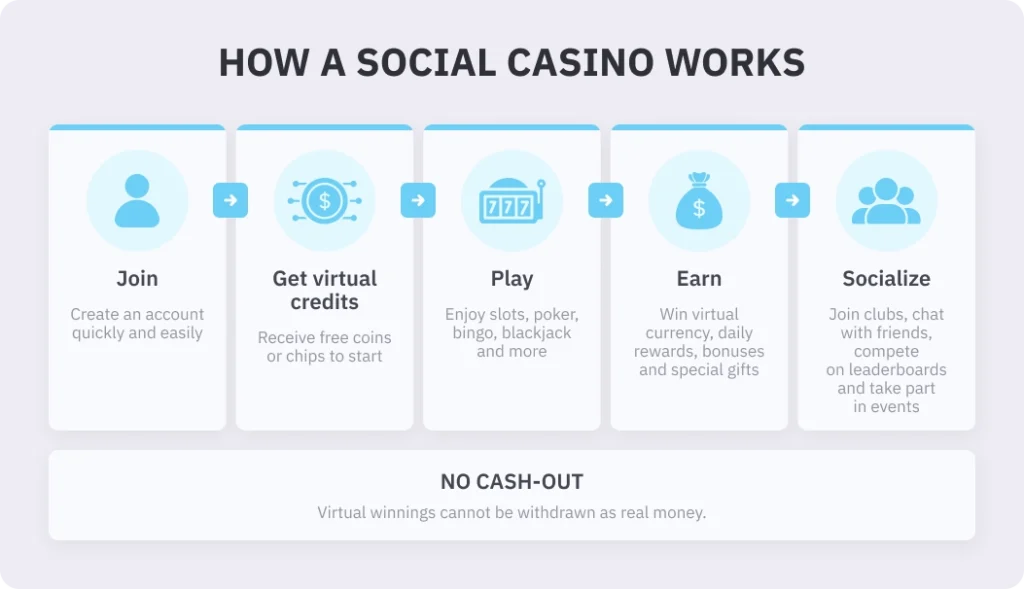
A social casino is an online gambling platform that features casino favourites, like slots, bingo, poker, and other game types, but plays for entertainment rather than cash winnings. Instead of staking real money, you receive in-game currency (often bought or earned) and use it to place bets and unlock features. The big difference from traditional online casinos is the lack of cash withdrawals as wins stay as virtual currency inside the platform, so the financial risk itself is much lower. Many titles also add leaderboards, gifting, and events, which makes the format feel closer to a social game than a gambling site.
Social casino gaming market overview
The social casino gaming market has moved beyond a niche, with global revenue estimated at $6.83 billion in 2022, after reaching $6.2 billion in gross gaming revenue (GGR) in 2020. In the US, it came in at about $1.8 billion in 2022 and is projected to hit $2.3 billion by 2026. Alongside revenue, the user base has been scaling as well, with more casual players spending time on repeat sessions and seasonal events.
User trends tell a similar story, with brands competing for the same traffic and relying more on paid acquisition and performance marketing. Liftoff and GameRefinery, major companies known for mobile growth data and game insights, analysed 83 billion ad impressions and 12 million installs, highlighting both the major upscale of demand and the cost of reaching new players.
The rise of social casinos
The birth and early roots (2000s)
The rise of social networking and online gaming helped set the stage for social casinos. When Facebook opened its Platform to third-party developers in May 2007, it paved the way for games built around friend lists, sharing, and viral invites. Those mechanics powered early hits like Mafia Wars and FarmVille, showing how fast social play could scale once it was tied to a network people already checked on a daily basis.
Casino play introduction (2010s)
As network-based play matured, casino-style formats became a natural next step for social gaming. Zynga Poker was launched in 2007 and quickly proved that in-game chips could support long sessions and monetization through virtual currency. Over time, social layers became a key, as leaderboards, leagues, and tournament formats helped turn quick hands into a routine.
Around the same period, Playtika entered the space with Slotomania, and its popularity highlighted the growing role of slot game development in free-play casino-style products.
The mobile gaming takeover
Smartphones pushed the format from “log in at a desk” to “play anywhere”. Apple launched the App Store in July 2008, making it easier to distribute and update games. As smartphone ownership climbed, mobile social gaming apps became the main growth engine. Better graphics, smoother performance, and always-on connectivity helped social casinos feel even closer to mainstream entertainment.
Today’s trends
Modern social gambling websites still rely on free-to-play casino games that run on virtual credits rather than requiring players to stake money, which keeps the experience accessible while lowering the financial commitment. Live events, time-limited challenges, and “return tomorrow” reward loops now sit alongside classic social features, like leaderboards. These are now part of the so-called freemium that regulators and researchers discuss when describing social-game design.
How to get started at online social casinos
To join a social casino online, you start with a quick sign-up on a website or mobile app, using an email, phone number, or an existing account from a social networking platform. New accounts receive a starter package of free chips, coins, or credits, acting as your virtual currency for playing.
From there, the path is simple: pick a game, place bets with your credits, and collect more through wins, daily log-in bonuses, missions, or gifts. Many sites make it easy for players to connect with friends, join clubs, and share progress on social media, which adds a community layer to the gameplay experience.
Since the majority of platforms run on a freemium model, you can keep playing just by topping up through rewards, or buy extra credits to speed things up. Leaderboards and tournaments are also in place to add competition with time-limited events that motivate regular play.
Reasons behind choosing social casinos
Social casinos appeal to casual users who want familiar casino-style gaming without the usual barriers, like withdrawals or ID checks. Most are free to start, quick to learn, and built around community features. To keep people coming back, many platforms use big data from gameplay patterns to shape progression and challenges, supporting long-term player engagement while still keeping the fun. The sections below cover the key reasons behind their popularity.
Easy, no-pressure entertainment
Most social casino games are free to play and run on virtual credits, so there’s no need to involve real cash to get started. Setup as such feels risk-free when compared with real-money gambling, even though optional purchases may still be available. Research on player motives also points to simple reasons like fun and excitement, along with stress relief.
Everyday convenience
Mobile access makes it easy to play on the move, whether you’re on a commute, having a lunch break, or at home on the sofa. Industry data also points to rising demand, with the mobile and tablet segment valued at $42.6 billion in 2024, driven by wider smart device use. As more play shifts to mobile, social casinos naturally benefit from the same habits.
Community play
Numerous studies show that people choose online social casino games because they help players connect with others, not only for entertainment. Survey-based research indicates that 29% of participants said they played for social reasons. Platforms reflect this with features like open chats, clubs, gifting, and leaderboards.
When real-money gambling isn’t an option
In places where real-money online casinos are limited or unavailable, social casinos can feel like the closest alternative. Because there are no cash prizes, some jurisdictions don’t classify them the same way as real-money gambling. As a result, social gambling can stay accessible even when online real-money play is restricted.
Privacy, security, and staying in control
Some players prefer not to share payment details at all, which can make the experience feel more comfortable from a privacy and security standpoint. That matters even more today, as users often feel they have limited control over how their information is collected, used, or shared.
Practice and learn rules without pressure
Social casinos can also work as a free-to-play practice space, especially for learning rules or testing game styles before deciding what you like. You can try out slots, poker hands, or bingo mechanics and get comfortable with the pace of play without worrying about losing cash.
Exploring types of social casino games
Social gaming platforms offer traditional casino games in a similar lobby setup to real-money sites, just with virtual credits instead of cash. Slots usually take the lead, ranging from classic 5×3 reels to modern formats with various bonus spins and theme-driven features. In addition, you will see casino table games, with roulette, poker, and blackjack offered in simplified versions that keep clear rules and quick rounds. Bingo remains a staple thanks to its easy mechanics and room-based play, while multiplayer card games bring head-to-head sessions and tournament-style formats.
As a casino games provider, BGaming also has several social-casino-style formats across different genres. For slot games, Potion Spells delivers a 7×7 cluster setup with refilling reels and frequent feature triggers. Multihand Blackjack Pro 2 would be your go-to card game option, letting players run multiple hands per round with in-game tips. On the casual games side, Aviamasters™ uses a popular crash-style format built around successfully landing a plane, while Plinko 2 adds adjustable risk and custom settings for more control over how each round plays out.
Major social casino platforms
When looking at social casino platforms, pay attention to how clearly they explain virtual credits, whether they run smoothly on mobile and desktop, and which community tools (clubs, chat, leaderboards) are actually supported. Here are a few popular examples:
- Zynga Poker — free-to-play Texas Hold’em that runs across iOS, Android, Facebook, and zyngapoker.com.
- Slotomania (Playtika) — promoted as 200+ premium slot machines, with new titles and classic casino games added regularly.
- Big Fish Casino — highlights over 100 free virtual slot machines and emphasizes club play with daily challenges and tournaments.
- Heart of Vegas — free-to-play slots with the Daily Wheel and Hourly Bonuses, listing branded content like Lightning/Dragon Link with a Hold & Spin feature.
- High 5 Casino — promotes around 1,500 social slots plus daily free coins, jackpots, and weekly new games.
Social casino licensing and compliance
Most social casinos sit outside standard gambling regulations because the concept of real-money wagering and cashing out winnings doesn’t apply. For instance, UKGC evidence states that if there is no prize with cash value, these games are not subject to gambling regulation.
For online casino operators, this can reduce the time and cost of market entry, since a full gambling licence is usually tied to taking deposits and paying out cash prizes. It can also keep the product accessible in stricter regions.
On top of that, there are operators, like High 5 Casino and Heart of Vegas, that are offering responsible gaming practices such as spend controls, cooldowns, and support links. Some also add provably fair tools to help users verify outcomes and build trust.
Social casino monetization
On mobile marketplaces, online casinos are often described as one of the top-grossing mobile gaming genres, and social casinos tap into similar spending habits without offering cash-out play. That revenue mainly comes from optional extras that extend play or speed up progress, so the core experience can stay free while still being commercially viable.
Rather than paying to enter, users typically spend through in-app purchases. Common buys include extra virtual chips or coins, premium packs, and boosters that unlock special features, refill balances faster, or keep streaks going when free credits run low. Anyone who prefers not to spend can usually regain their virtual currency through daily rewards, missions, and timed gifts. This is where most monetization happens, creating a clear shift from free-to-play to pay-to-play for users who want more control.
Another income stream comes from advertising that actually pays social casino gamers instead of just interrupting them. Rewarded video is widely used because it grants in-game currency or items after a short ad.For steadier income, many brands sell subscription services that bundle VIP perks such as ad-free sessions, larger daily coin drops, or access to exclusive rooms. Seasonal tournaments and promotions often lift spending because limited-time leaderboards and milestone rewards encourage players to buy event bundles, entry tickets, or boosters to stay competitive.
Clear advantages
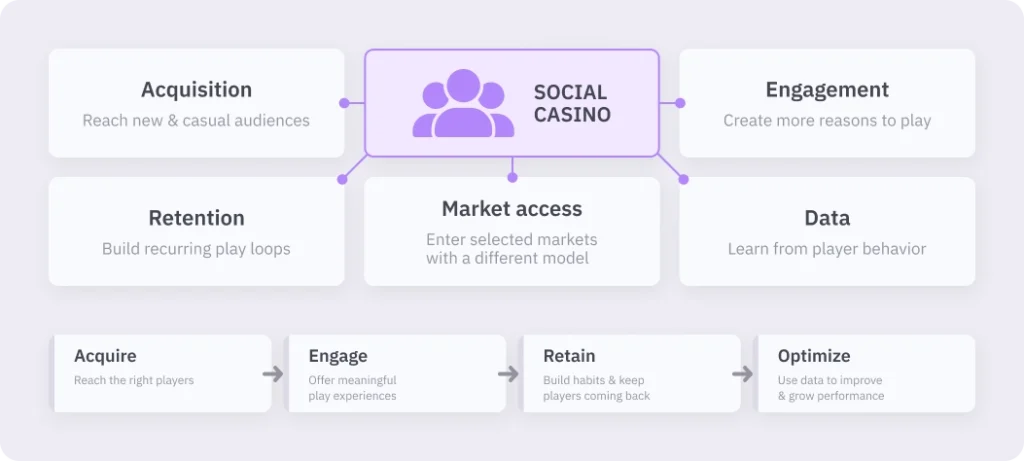
When compared to the usual online casino operators, social gaming websites offer a way to grow an audience without the hassle tied to real-money play. That no-risk style of gaming is easier to market to casual users and can open doors in regions where real-money play is restricted or harder to launch.
Player clubs, gifting, chat, shared missions, and competitive boards use social networking mechanics to keep communities active. These features create routine touchpoints, so players return for group goals, weekly challenges, or leaderboard climbs even when they are not spending. The lack of cash-outs also makes operations more predictable and easier to manage, since support teams deal with fewer high-stakes issues like withdrawal delays, KYC disputes, and payout-related fraud attempts.
Behavior tracking is another major advantage. Every session helps social casino teams to understand player behaviour, such as when users drop off, what triggers a return, and which offers are favored. That makes A/B testing significantly easier, from sign-up screens to pricing and event timing.
Finally, the “no cash-out” format can support responsible gaming messaging by positioning the product as entertainment first, with lower financial pressure than a real-money play.
Where social casinos are heading
Recent market forecasts point out that social casinos are expected to keep growing through the second half of the decade. Industry projections put the US market at about $2.3 billion in 2026, while the global market is forecast to reach roughly $9.82 billion by 2028. Looking further ahead, estimates place the sector at around $12.53 billion by 2030, which works out to about 8.4% CAGR.
Faster connections through 5G technology can reduce lag and improve streaming quality, which provides smoother real-time multiplayer play, live chat, advanced leaderboards, and more accessible augmented reality (AR) / virtual reality (VR) experiences. On top of that, as mobile play grows, people share results and invite friends through social apps more often, making group play easier to start.
With design also shifting toward full game-style progression, you will likely see more gamification through quests, collections, streaks, and club goals, along with RPG-style elements such as avatars, maps, and unlockable zones. That structure fits story-driven slot games, where progress and narrative are as important as spins and bonus rounds.
Research on free-to-play games shows that AI-driven personalization (e.g., adjusting difficulty per player) can increase engagement and boost revenue from in-app purchases. In social casinos, that can mean missions and events that match how someone plays, making the experience more relevant.
There are also instances when social gambling content raises questions around youth access and data handling. For example, the UK ICO’s Children’s Code sets 15 standards for online services likely to be used by under-18s. It pushes clearer data practices, safer defaults, stronger age gating, and parental controls, which could influence similar standards in other countries over time.
FAQ
What is a social casino?
A social casino is a casino-style game platform where you play slots, poker, blackjack, or bingo with virtual credits. You can’t withdraw winnings as cash. The model focuses on entertainment and social features, while optional purchases can top up credits.
How is a social casino different from a real-money casino?
A traditional online casino takes real-money bets and can pay out cash winnings under a gambling license. A social casino uses virtual currencies, doesn’t offer cash withdrawals, and usually sits outside usual gambling regulation.
Are social casinos allowed by law?
Often yes, because there’s no real-money wagering or cash prizes, but legality depends on local laws and on the exact model. Apps that use virtual coins often face fewer gambling-law requirements because there’s no cash-out.
Can you play online social casinos without spending money?
Usually, social casinos are free to start and include daily bonuses or missions that refill your virtual credits. You can play without paying, but progress may slow when credits run out. Optional in-app purchases, subscriptions, or rewarded ads provide extra credits and perks.
Is it safe to access social casino sites and apps?
Social casinos use standard safety measures, like account logins, fraud monitoring, and secure payment processing for purchases. Many also offer privacy controls and responsible gaming tools such as spend limits, time-outs, and reminders.
How does a social casino work in practice?
You sign up, get a starter balance of coins, then play slots or tables using that virtual currency. These credits come from wins, daily logins, missions, and gifts. Leaderboards, clubs, and tournaments add competition and an opportunity to win even more credits.
Are social casino operators licensed?
As a rule, social casino operators don’t need a license like regular gambling websites, since play uses virtual currency and there’s no real-money bets or cash withdrawals. Still, certain rules can apply around consumer protection, advertising, and data privacy.
Do social casino operators make money?
Yes, social casinos are profitable! Their main revenue comes from optional in-app purchases, ads, and subscriptions, not house edge cash wagering. Strong player retention and smart event design matter as much as payout odds.

Let’s start a conversation
Would you like to start conversation with BGaming in any field? Drop us a line!
CONTACT US