Let’s start a conversation
Would you like to start conversation with BGaming in any field? Drop us a line!
CONTACT USiGaming trends 2026: key technologies and market shifts
A more complex market is taking shape in 2026, and the latest iGaming industry trends show just how quickly priorities are shifting across the sector. This article explores which market dynamics, regulatory changes, marketing patterns, and technology moves are guiding the space, and which weak points businesses can no longer ignore.
iGaming market trends: revenue, size, and market direction
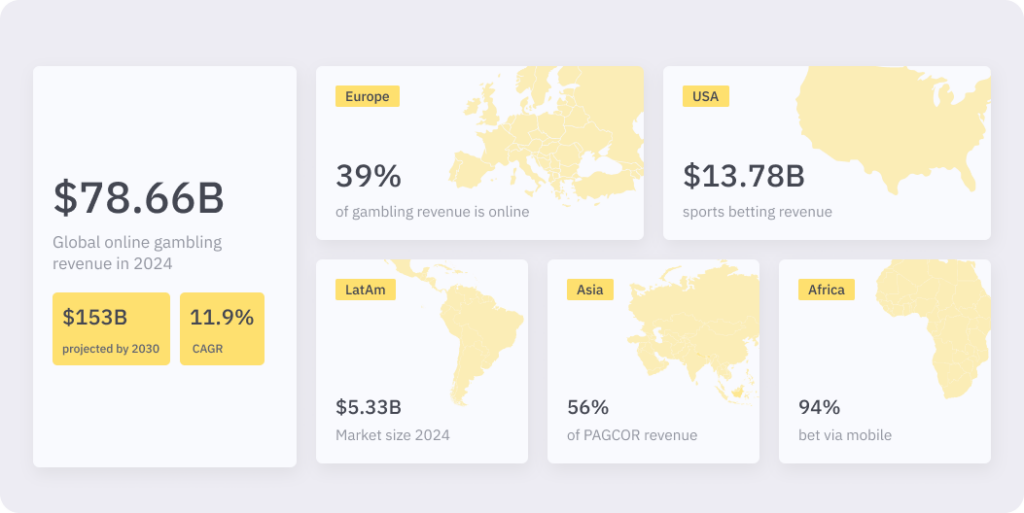
Global growth remains the clearest starting point for understanding iGaming market trends in 2026. Recent market research estimates online gambling revenue at $78.66 billion in 2024 and projects the market size to reach $153.57 billion by 2030, which reflects an 11.9% CAGR. That pace shows a category still expanding at scale, but the bigger story is no longer the growth alone. The market is becoming more layered, with stronger segmentation opening up new opportunities across product types, payment habits, device use, and regional regulation.
If we take a closer look at the regulated markets, Europe continues to set the tone for the wider sector, especially because online gambling keeps gaining share inside a mature and highly regulated environment. At the same time, the US remains one of the fastest-moving expansion stories, while LatAm is progressing through legalization and market opening. Asia and Africa also deserve more attention than before, not only because of rising adoption, but because local behavior is shaping distinct microtrends around mobile use, payments, and sports-led play. Together, these regional differences point to a broader macrotrend in 2026, as online gambling growth is becoming more geographically diversified.
At a more practical level, operators are also adapting to localized content, region-specific acquisition tactics, and platform setups built around faster compliance, retention, and personalization.
Regional breakdown: EU, US, LatAm, Asia, and Africa
Europe remains the largest regulated market cluster in iGaming. Online already accounted for 39% of total European gambling revenue in 2024, which means operators entering or expanding in the EU need to think less about basic demand and more about licensing fit, compliance depth, and country-level segmentation.
Across the US, momentum is still being driven mainly by sports betting, while iGaming remains concentrated in a limited number of active states. Industry figures show sports betting revenue reached $13.78 billion in 2024, versus $8.41 billion from regulated iGaming in seven states, so operators in 2026 still need a state-by-state approach built around market access, tax structure, and product mix.
LatAm is also spiking with the regional online gambling market reaching $5.33 billion in 2024, and Brazil is widely seen as the main growth driver. The country’s regulated fixed-odds betting market opened on 1 January 2025, turning compliance, local payments, and brand trust into immediate priorities for operators targeting the region.
Asia is harder to treat as a single market because the region remains split between tightly regulated jurisdictions and faster-moving licensed hubs. Recent revenue updates from the Philippines show online gambling already accounted for 56% of PAGCOR’s Q1 2025 revenue, which highlights where digital growth is concentrating.
Africa’s iGaming sector is largely built around mobile play. Recent survey data shows 94% of African bettors place wagers through a mobile phone, so operators looking at the continent in 2026 should prioritize lightweight product design, local payment flows, and sports-led user journeys rather than desktop-first models.
The regulatory turn
More growth is now happening inside regulated markets, which is changing how the iGaming ecosystem operates day to day. Licensing is becoming more fragmented, market entry is taking longer, and compliance now reaches far beyond basic approval checks. In Europe alone, leading operators collectively hold 321 online gambling licenses across 21 countries, underscoring how country-specific the regulatory landscape has become. Brazil, which already came up earlier, also stands out as one of the clearest examples of tighter regulation. From the start of 2025, only locally incorporated and authorized operators have been allowed to run online betting nationwide under stricter legal, technical, financial, and consumer protection rules.
Responsible gaming is moving closer to the center of licensing expectations, and in the US, about two-thirds of commercial gaming jurisdictions now require operators to file responsible gaming plans, while more than 80% have detailed advertising rules in place.
Newer requirements increasingly cover data-driven intervention tools, wager or time limits, employee training, and tighter restrictions on marketing exposure to underage audiences. For operators in 2026, that means compliance is no longer just a legal layer around the product. It is becoming part of product design, player communication, onboarding flows, and retention strategy.
The new player acquisition landscape
Advertising rules are getting tighter, affecting how operators treat visibility, targeting, and brand growth. At the same time, iGaming marketing trends are becoming more data-driven and more decentralized, as brands spread spending across creators, affiliates, search, and owned channels. And let’s not forget about AI, which is now used more to group users and show offers at the right time, while mobile-first user journeys are being designed to make registration faster and easier. On top of that, in 2026, operators are noticeably moving away from broad reach and toward quality-driven acquisition, tighter localization, and campaigns that can perform under heavier regulatory scrutiny.
Micro-targeting and data-driven segmentation
Registration volume on its own tells operators far less than it used to. Personalization now sits much closer to the center of acquisition strategy, as brands sort audiences by player behavior, spending patterns, session depth, game preference, and response to specific offers. This change is pushing teams away from broad campaign logic and toward data-driven segmentation built around quality, intent, and long-term value. The goal is no longer to reach the widest possible audience, but to identify which users are more likely to convert, stay active, and contribute to player retention over time.
More advanced setups now combine engagement patterns, predictive analytics, and AI algorithms to build micro-segmentation systems that adjust messaging and bonus logic with greater precision. A sports-led user, for example, may respond to a completely different conversion path than a casual slots player or a high-frequency mobile bettor.
Operators are also leaning more heavily on AI-powered attribution models, including lifetime value prediction and churn prediction models, to understand which touchpoints actually support player engagement, rather than giving too much weight to the final click alone. The result is a more selective approach to growth, with predictive paths helping teams prioritize personalization and reduce wasted spend across the acquisition cycle.
Creator and influencer market
Traditional PPC has become harder to scale cleanly for gambling brands, which is one reason influencer marketing is moving closer to the center of acquisition strategy. Google allows gambling ads only in approved countries and under certification rules, and it tightened certification requirements again in March 2026. Meta also requires prior authorization for online gambling and gaming ads, while TikTok limits casino advertising to specified legal markets, age-restricted audiences, and verified advertisers.
That pressure is pushing more iGaming brands toward creator-led formats that feel less like direct ads and more like trusted distribution. Live streaming on Twitch and YouTube is especially useful here because it gives a casino brand more room to explain products, react in real time, and build familiarity through ongoing community contact. YouTube’s own live tools are built around chat, real-time interaction, and a more authentic viewing experience, which fits naturally with creator campaigns.
SEO and the rise of AI search
SEO remains one of the few reliable growth channels for iGaming brands that does not depend too heavily on paid ads. Its role is becoming even more important as search powered by AI changes the way users discover content. Google’s AI search features still rely on the same core signals as regular Search, such as accessible pages, structured data, and trustworthy information. ChatGPT Search and Perplexity work in a similar way by using web sources and showing citations. As a result, SEO-oriented content now needs to be more than keyword-focused — it has to be clear, credible, and easy for AI systems to process and trust.
iGaming SEO trends in 2026 favor expert-based long reads, clear page structure, stronger entity signals around the casino brand, and trust indicators such as transparent authorship, source-backed claims, and regularly refreshed facts. Verified information matters more because AI systems are designed to compare sources and choose material that is original, useful, and tied to real expertise. Pages that explain a topic clearly and support it with reliable information are more likely to earn visibility than shallow content built only around keyword coverage.
Affiliate marketing
Traffic and affiliate partnerships still do a lot of heavy lifting, but current iGaming affiliate trends are making this channel far more compliance-driven than it used to be. In Great Britain, the Gambling Commission says operators remain primarily responsible for breaches committed by affiliates, highlighting the direct marketing to self-excluded customers. CAP and ASA guidance also makes clear that affiliate and influencer posts using links or codes must be obviously identifiable as advertising.
A 2025 affiliate marketing study based on more than 1,500 marketers, publishers, and creators found that 97% of brands and 96% of creators already use AI in partnership programs, while 94% are experimenting with or planning attribution models beyond last click. Instead of judging partners mainly by traffic volume, operators are putting more focus on player value, retention, and deposit quality, while also expanding the use of localized pages and AI-assisted content. Some platforms are also pushing blockchain-based attribution and immutable tracking as a way to reduce disputes and improve trust across payouts and reporting.
Alternative advertising channels
More operators moving beyond search and social ads and placing greater attention on mobile gaming environments as an acquisition channel. Native ads, in-app networks, push formats, and full-screen ads are becoming more common because they fit mobile behavior better than standard banner placements. Instead of interrupting the user too aggressively, these formats can appear more naturally within the app experience and create a smoother path to the casino brand.
Programmatic advertising is also becoming more useful because it gives operators access to more mobile ad space and greater flexibility in how campaigns are delivered. That includes video, interactive ads, and other entertainment-driven ad formats that give brands more room to show product atmosphere and short-form messaging.
iGaming technology trends
Fraud prevention, more efficient secure payment methods, and faster regulatory responses are becoming some of the main forces shaping iGaming technology trends in 2026. That is why technology is no longer limited to front-end performance. Industry and regulatory reporting point in the same direction, with operators putting more weight on compliance-driven innovation. Real-time systems, AI-driven decision-making, mobile technologies, and stronger data operations are now moving into the core stack.
Artificial intelligence and machine learning
What makes AI more important in 2026 is not hype, but its growing role in analyzing player behavior, supporting faster decisions, and reducing manual workload. Recent industry reporting also shows a greater focus on personalized interventions based on player behavior, such as changes in deposit and betting patterns, which is bringing AI closer to responsible gaming. Beyond that, AI-agents are starting to look more relevant for multi-step workflows such as support handling, compliance review, and risk escalation. To make those systems work reliably at scale, operators also need stronger Data and MLOps, with tighter model monitoring and clearer retraining rules across the platform.
Blockchain and crypto
Cross-border payments are among the clearest reasons the integration of blockchain technology is staying relevant in iGaming. For crypto casinos, the appeal is becoming more practical than experimental, with faster transfers, more transparent transaction records, and secure payment methods that can support international users. In Europe, MiCA has introduced uniform rules for crypto-assets around transparency, authorization, and supervision. That means operators now have to treat crypto as both a payment tool and a compliance consideration, which is bringing blockchain further into the mainstream.
Mobile-first architecture
Smartphone use and high-speed internet remain major drivers of online gambling growth, which is why mobile technologies now shape product architecture right from the start. Operators are building lighter front ends, faster onboarding flows, cleaner wallet access, and session logic that works across smaller screens and unstable connections. The rise of 5G connections adds more room for richer interfaces, quicker loading, and stronger live features, yet speed alone is not the main goal here.
Cybersecurity and risk prevention
Fraud pressure is rising at the same time as compliance expectations are getting stricter, which is making cybersecurity a central part of iGaming operations. Industry data shows that 82.9% of operators experienced more fraud over the previous year, with many attacks now peaking between 4 a.m. and 8 a.m., when compliance teams are less likely to be fully active. This tendency pushes operators toward stronger identity checks, 24/7 automated monitoring, and risk prevention systems that can react faster to account takeovers, bonus abuse, synthetic identities, and suspicious betting behavior. A clearer risk profile around each player is becoming more important, helping operators connect fraud controls, payment checks, and responsible gaming measures instead of running them as separate tasks.
Real-time data infrastructure
Wallet balances, bet outcomes, bonus status, and player limits all need to stay in sync instantly, which makes real-time data infrastructure a core part of modern iGaming operations. For that reason, real-time data infrastructure is becoming a core requirement in iGaming rather than a back-end upgrade. Event-driven systems are designed to process changes as they happen instead of waiting for batch updates, which helps platforms react faster. Data and MLOps matter here as well, because machine learning systems only work reliably when live data is clean, monitored, and delivered in a stable way.
Automation in operations and game delivery
Stable, compliant launches are becoming a higher priority because operators now manage more content, more updates, and more market-specific requirements at once. Automation in operations and game delivery is a much bigger deal in 2026 as automated release workflows help teams build, test, launch, and monitor code changes continuously, reducing manual work and lowering the risk of rollout errors. AI-agents are also starting to support routine workflows such as support actions, incident handling, and document-heavy review tasks. These tools help operators shorten release cycles, reduce operational bottlenecks, and manage game delivery with more control across testing, launch, and post-release monitoring.
Personalization
Personalization is moving beyond bonus emails and now shapes what players see after login, how offers are timed, and when safer-play messages appear. Recent EGBA reporting says personalized messages are being measured for their effect on deposit patterns and betting behavior, while UK guidance requires operators to monitor customer activity and respond when harm indicators appear. AI-driven systems are now moving deeper into the product layer instead of staying limited to marketing tasks, with more attention on behavioral KPIs. Lobbies, promo timing, game suggestions, and limit prompts are increasingly being adjusted around players’ behavior, session history, and risk signals.
AR and VR
The wider AR/VR market is projected to grow from $40.76 billion in 2026 to $441.51 billion by 2034. Virtual casino environments, interactive live dealer rooms, and 3D slot interfaces can make play feel more social, more visual, and more immediate than a standard screen-based session. In these formats, players can move through an online casino space, react in real time, and spend longer inside the experience. Better connectivity is part of the reason, with 5G connections supporting lower latency and stronger real-time performance. Hardware is also becoming more mainstream, with XR device shipments rising 44.4% in 2025 as devices became more and more user-friendly.
iGaming development trends
Product development is changing just as quickly as marketing and technology, with studios under more pressure to create games that are better aligned with player expectations. In 2026, iGaming development trends are shaped by content variety, mobile-first design, social mechanics, and stronger retention tools.
Slot development
Slots remain the core product in most online casinos, but the standards behind their design have moved much higher. Mobile-first design now leans heavily into custom slot development, with studios focusing on lighter layouts, sharper performance, and high-quality animation that still runs smoothly across devices. On the math side, volatile models, bonus-buy mechanics, cluster pays, and MEGAWAYS™-style reel structures continue to shape how modern releases are designed and positioned. Social-inspired mechanics, branded content, and stronger visual identity are also becoming more common as providers look for clearer differentiation. At the platform level, casino games integration needs to support smoother launches, flexible feature settings, and RTP localization strategies for regulated markets.
Popular game types
Online casino games, live dealers, mobile sports titles, and even e-sports betting do not carry the same weight in every market, because local habits, device preferences, and session length shape demand differently.
- Europe: slots remain the backbone, while live dealer games such as blackjack and roulette hold a stronger position.
- LatAm: crash games, slot tournaments, instant-win titles, and high-energy live casino formats perform well, especially on mobile.
- India: mobile sports games still dominate attention, and the country remains heavily mobile-led, driven by strong smartphone adoption and growing interest in online sports betting.
- Africa: crash games, instant-win titles, and live dealer formats are gaining strong traction, largely because they fit mobile-led play and shorter sessions well.
- North America: sports betting still leads overall, but online casino games such as slots, blackjack, and roulette also hold a strong place in regulated iGaming states.
Social casino
Social casino games are growing as a format of their own, with recent market research valuing the segment at $9.36 billion in 2025 and projecting it to reach $14.31 billion by 2030. What keeps this category popular is not cash payout, but the mix of low-friction play, daily rewards, leaderboards, and familiar casino-style mechanics. Social game casino development is useful not only for retention, but also for audience expansion and longer-term brand visibility.
Gamification
Gamification has become a core retention tool because it gives players more to follow than a single session or bonus cycle. Progress bars, missions, unlockable rewards, levels, and time-based challenges create a stronger sense of involvement, which helps player engagement feel more continuous over time. Since users are more likely to return when the product gives them visible goals and a reason to keep progressing, gamification also plays an important role in loyalty, not just activity.
Rewards
Reward systems are becoming more selective, because broad bonus distribution no longer gives operators the same return it once did. In 2026, iGaming rewards are increasingly shaped by player value, session frequency, and deposit behavior, with AI-driven optimization helping teams decide who should receive an offer, when it should appear, and what format makes most sense. That shift is changing how cashback, free spins, loyalty points, reloads, and milestone bonuses are used across the product. When reward logic is handled with more precision, promotions feel more relevant to players and easier to control from a business perspective, giving operators a stronger balance between retention, repeat activity, and promotional cost.
Role of game providers
Partnerships with game providers now cover much more than content supply. Operators want games that fit local rules, work well on mobile, and launch reliably across different markets. Good providers also stay involved after release by improving game balance, supporting responsible gaming, and using analytics, retention tools, and game customization to keep content performing well. The strongest partnerships support the full cycle, from market entry and rollout to long-term optimization once the games are live.
What this means for BGaming
As an iGaming provider, BGaming is moving across a wider mix of formats and mechanics that match the direction of the market. Aviamasters™ 2 is one of the clearer examples from the 2026 line-up, expanding the original “LAND!” mechanic with Boosters, a Safe Landing mode, and multipliers up to ×1,000. Gates of Power points to modern high-volatility slot design through pay-anywhere mechanics, four Buy options, and a transparent multiplier system. Sugar Merge Up™ fits the push toward social-style, watchable gameplay, while Royal Roulette 500X updates classic table content with Lightning multipliers and Strategy Mode. Staying aligned with market shifts is now essential for online slot providers, as player expectations, mechanics, and delivery standards continue to evolve.
Key takeaways
The 2026 iGaming trends show a market that is still growing, but also becoming harder to navigate without stronger localization, cleaner compliance, and sharper product thinking. Scale alone is no longer enough, as operators now need better targeting, faster infrastructure, and more adaptable content to stay competitive.
- Growth remains strong, but regulated markets are becoming more fragmented and more demanding.
- Acquisition is moving toward higher-quality traffic, creator-led reach, SEO visibility, and smarter segmentation.
- Technology now supports core operations through AI, real-time data, cybersecurity, mobile-first design, and automation.
- Development is shifting toward stronger mechanics, social-style formats, gamification, smarter rewards, and closer provider partnerships.
- Regional differences matter more, with Europe, the US, LatAm, Asia, Africa, and India each showing different product and market-entry priorities.
- Compliance now reaches deeper into product, marketing, and retention, not just licensing and legal setup.
FAQ
What does online gambling market growth mean?
It means rising revenue, wider regulated-market expansion, stronger digital adoption, and growing demand across products, regions, and devices, not just more raw traffic or betting volume.
What are the main drivers of the online gambling industry?
The main drivers are mobile access, digital payments, legalization, localized content, faster compliance-ready platforms, and personalization that improves retention and supports more efficient growth.
What trends are defining the iGaming market in 2026?
The defining 2026 trends are tighter regulation, AI-driven operations, smarter segmentation, creator-led acquisition, AI-search SEO, mobile-first design, stronger cybersecurity, and retention-focused product development.
Which regions stand out most in the iGaming market in 2026?
Brazil and wider LatAm stand out for regulatory momentum after Brazil’s regulated betting market opened on 1 January 2025, while Europe leads in scale and maturity, the US in sports-led expansion, Asia in digital growth hubs, and Africa in mobile-first demand.
Which current iGaming trends support stronger player engagement?
Personalization, gamification, and smarter rewards support stronger engagement by making the experience feel more relevant, more goal-driven, and more rewarding over time. Together, they help players return more often, stay active longer, and build stronger loyalty.
How is AI impacting the current state of the iGaming industry?
AI is helping operators work faster and more precisely by improving how they read player behavior, detect risk, automate routine decisions, and adjust retention efforts in real time. It also helps them respond earlier to fraud signals, support needs, and changes in player activity.
Why is it important for operators to track iGaming trends today?
Tracking trends helps operators adjust before the market moves against them. It gives them more time to respond to new rules, changing player behavior.
Which factors may hold back the iGaming market growth in 2026?
Growth may slow when operators face tougher market conditions without adapting fast enough, as stricter rules, rising costs, fraud risk, and weak local fit can all reduce expansion.

Let’s start a conversation
Would you like to start conversation with BGaming in any field? Drop us a line!
CONTACT US